
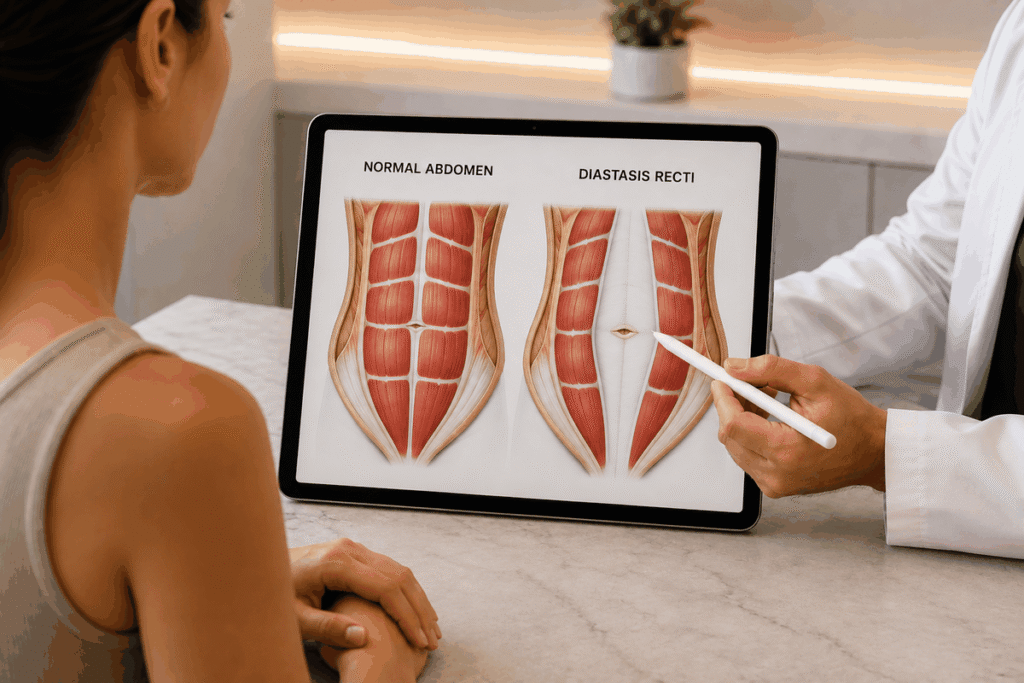
Patients considering a tummy tuck (abdominoplasty) often ask about two conditions that can cause abdominal bulging: diastasis recti and/or abdominal hernias. Although they may look similar, they are different problems. Understanding the difference is important when planning any abdominal surgery.
What Is Diastasis Recti?
Diastasis recti occurs when the rectus abdominis muscles (the “six-pack” muscles) separate along the midline of the abdomen. It commonly develops following pregnancy, significant weight changes, or stretching of the abdominal wall.
Importantly, diastasis recti is not a true hernia. There is no actual hole or defect in the abdominal wall. Instead, the connective tissue between the muscles has stretched and widened.
During a tummy tuck, the abdominal wall can often be tightened by bringing the separated muscles back toward the midline with sutures, a technique commonly referred to as muscle repair or rectus plication. Combined with removal of excess abdominal skin, this can create a flatter, firmer abdominal contour.
How Is an Abdominal Hernia Different?
An abdominal hernia is a true defect or hole that is opening in the abdominal wall through which fat, tissue, or sometimes intestine can protrude. Common examples include umbilical, ventral, and incisional hernias.
Some small, uncomplicated hernias may be repaired at the same time as a tummy tuck. Combining procedures can allow appropriate patients to address the abdominal wall defect, diastasis, and excess skin during one operation.
However, hernia size, location, complexity, prior repairs, and the possible need for mesh can change the surgical plan. Repair around the belly button also requires particular attention to preserving its blood supply.
For larger or more complex hernias, your plastic surgeon may recommend involving a general surgeon or abdominal wall/hernia specialist. In selected cases, the surgeons can work together during the same operation: the hernia surgeon addresses the abdominal wall defect while the plastic surgeon performs the tummy tuck, muscle tightening, and aesthetic contouring.
Ultimately, treatment should be individualized. If you have diastasis recti, an abdominal hernia, or both, a thorough examination before tummy tuck surgery can determine the safest approach and whether a combined repair is appropriate.
What If I Only Want Liposuction?
Some patients with abdominal fullness ask whether liposuction can be performed instead of a tummy tuck, particularly if they want to avoid the longer incision associated with abdominoplasty. The answer depends on what is actually causing the abdominal bulge.
Liposuction removes excess fat, but it does not repair diastasis recti or an abdominal hernia. If the primary concern is localized fat and the abdominal skin has good elasticity, liposuction alone may provide an excellent improvement in abdominal contour. However, it is important to note that liposuction is not a weight loss procedure. Rather, it is a body contouring and shaping surgery.
However, when abdominal protrusion is caused partly by separation of the abdominal muscles (diastasis recti) or a hernia, removing fat alone will not correct the underlying muscle separation. In fact, sometimes removing fat from liposuction can make this protrusion even more obvious because the layer of fat that ordinarily would camouflage the fat will be removed. Sometimes, patients with a diastasis or a large hernia mistake their protrusion as just fat, when in reality it is something abnormal with the abdominal wall that needs to be reconstructed.
This distinction is especially important after pregnancy or significant weight loss. A patient may have a combination of excess fat, loose skin, diastasis recti, and occasionally a hernia. In these situations, a tummy tuck with muscle repair, sometimes combined with liposuction, may provide a more comprehensive improvement than liposuction alone.
The best procedure therefore depends on your anatomy rather than simply choosing between “liposuction or tummy tuck.” A physical examination can determine whether the abdominal fullness comes primarily from fat, loose skin, muscle separation, a hernia—or a combination of these factors—and help establish the safest and most effective treatment plan.
Meet Dr. Brian Bassiri-Tehrani
Dr. Brian Bassiri-Tehrani is a double board-certified plastic surgeon with extensive training and expertise in tummy tuck, liposuction and body contouring in NYC. He will guide you through every step of the process to ensure your safety and to optimize your results. To make an appointment, call (212) 540-6868 or click here.